Development Trends of Smart Paving Technology and Environmentally Friendly Accessories and Consumables in 2026
With the global advancement of the "dual carbon" goals, the acceleration of new urbanization and the implementation of smart infrastructure, the industry of intelligent paving technology and environmental accessories & consumables is experiencing explosive growth, emerging as a core track for the transformation and upgrading of the building materials sector. This paper focuses on the core development trends of the industry, compares the domestic and international differences in technology, market and application, sorts out 10 core trends, and comprehensively analyzes the industry development context. It provides references for practitioners and investors, and boosts the high-quality green and intelligent development of the industry.
I. Comparative Analysis of Domestic and International Differences in Intelligent Paving Technology and Environmental Accessories & Consumables
At present, the global intelligent paving and environmental accessories & consumables industry all features the core orientation of "intelligence empowerment and environmental protection priority". However, due to disparities in technological accumulation, policy orientation, market demand and industrial chain maturity, there are significant domestic and international differences in technological application, product layout and scenario implementation, which are specifically reflected in four dimensions, focusing on intelligent paving technology, environmental accessories & consumables, market application and policy support.
(I) Technological Application: Foreign Countries Lead High-end Innovation, While China Focuses on Localized Implementation and Adaptation
Relying on years of technological accumulation, foreign countries (mainly Europe, the United States and Japan) occupy a leading position in the core technologies of intelligent paving, focusing on "full-process intellectualization + multi-functional integration". For example, Germany's digital twin paving system and Japan's self-repairing environmental paving technology realize the full-chain coverage of digital construction management, real-time pavement condition monitoring and environmental recycling of consumables. Technological iteration centers on "high-endization and refinement", focusing on solving paving pain points in complex scenarios such as adaptation to extreme climates and long-life operation and maintenance. The annual number of patent applications for relevant intelligent paving technologies accounts for more than 60% of the global total, with a high barrier for core technologies.
Intelligent paving technology in China started late but has developed at a rapid pace, with core advantages in "localized technological adaptation + cost control". It focuses on integrating mature technologies with domestic infrastructure scenarios, such as permeable paving for sponge cities and intelligent monitoring paving for municipal roads, and has achieved rapid breakthroughs in BIM collaborative design, modular prefabricated paving and other fields. At present, 7 out of the top 10 domestic paving stone manufacturers have built intelligent production lines, with an average energy consumption reduction of 18% and a yield rate of 96%. However, China still relies on imports for core components such as core chips and high-end sensors. Technological iteration is centered on "practicality and large-scale application", prioritizing the solution of industry pain points such as "high implementation cost and low construction efficiency", and gradually narrowing the technological gap with foreign countries. The number of domestic patent applications for relevant core technologies increased by 15% from 2024 to 2025.
(II) Environmental Accessories & Consumables: Foreign Countries Focus on Whole-life Cycle Circulation, While China Prioritizes Meeting Basic Environmental Standards
The core orientation of foreign environmental accessories & consumables is "whole-life cycle environmental protection", forming a complete environmental closed loop from raw material mining, production and processing to use, scrapping, recycling and reuse. For example, European and American countries widely use environmentally friendly consumables such as recycled aggregate and bio-based adhesives; the penetration rate of green products such as recycled aggregate and permeable asphalt has reached nearly 30%, and the recovery rate of scrapped paving materials is over 80%. In addition, the environmental standards for consumables are stringent, which not only require zero emission of harmful substances such as formaldehyde and heavy metals, but also impose strict control over carbon emissions. For example, the EU EPD certification and California Proposition 65 have clearly put forward environmental requirements for paving consumables, driving enterprises to develop high-end environmentally friendly consumables with low energy consumption and recyclability.
China's environmental accessories & consumables are currently in the stage of "transition from meeting basic environmental standards to recycling", focusing on "environmental protection in the use stage" and mainly solving basic problems such as "excessive formaldehyde emission and pollution discharge". The output of environmentally friendly products such as recycled concrete bricks, permeable bricks and artificial quartz stones has witnessed a significant growth, with a year-on-year increase of 18.9%, 15.7% and 12.3% respectively. In recent years, with the advancement of the "dual carbon" goals, domestic enterprises have gradually increased R&D investment in recycled and low-carbon consumables, and many regions have mandated a minimum 30% proportion of recycled materials in application. For example, Shenzhen has included recycled paving bricks in the mandatory indicators for municipal procurement. However, China still lags behind foreign countries in the construction of consumables recycling systems and the R&D of high-end environmental raw materials, with the recovery rate of scrapped paving materials less than 50% and low added value of environmental consumables.
(III) Market Application: Diversified Foreign Scenarios vs.
China's Focus on Infrastructural Rigid Demand
The application scenarios of intelligent paving and environmental accessories & consumables in foreign countries are characterized by "diversification and high-endization", covering not only basic infrastructure such as municipal roads and bridges, but also widely used in high-end residential buildings, commercial complexes, sports venues, cultural and tourism projects and other scenarios. For example, Japan's intelligent anti-skid paving is applied in elderly communities, and European and American environmental permeable paving is used in high-end villa areas, with an emphasis on "humanized and personalized" adaptation. At the same time, the demand in the high-end market is strong, and the import and export price gap of high value-added functional paving materials continues to widen. New cooperation models such as Materials as a Service (MaaS) and performance guarantee contracts account for 18% of large-scale projects.
China's market application mainly focuses on "infrastructural rigid demand", with core scenarios including municipal road construction, sponge city development, old community renovation and rural revitalization infrastructure. By the end of 2023, 297 cities across the country had launched renewal pilots, with a total of 186,000 old communities renovated, driving a surge in demand for permeable paving consumables, which accounts for more than 70% of the total demand. With the upgrading of domestic consumption, the demand for high-end residential buildings, commercial complexes and other scenarios is gradually increasing. Benchmark projects in Xiong'an New Area, Guangzhou, Changsha and other places generally adopt high value-added composite paving systems with a unit price of 600-1200 CNY per square meter. However, the overall market is still dominated by "large-scale and rigid demand", with a lower degree of scenario diversification than foreign countries and a low penetration rate in the high-end market.
(IV) Policy Support: Foreign Countries Emphasize Environmental Constraints, While China Focuses on Incentives and Guidance
Foreign policies are mainly based on "stringent environmental constraints + moderate incentives". They force enterprises to transform and upgrade by formulating strict environmental standards and penalty mechanisms. For example, the European Union has imposed strict control over the import of high-carbon paving consumables through the Carbon Border Adjustment Mechanism (CBAM), and more than 50 countries have incorporated green paving standards into mandatory building codes. At the same time, tax reductions, subsidies and other supports are given to enterprises engaged in R&D of environmental and intelligent paving technologies to promote the transformation of the industry towards greenization and intellectualization.
China's policies focus on "incentives and guidance + standard improvement". In recent years, policies such as the 14th Five-Year Plan for Building Energy Conservation and Green Building Development and the Carbon Peak Implementation Plan for the Building Materials Industry have been issued successively, clearly proposing to promote the application of intelligent paving and environmental consumables. The Ministry of Housing and Urban-Rural Development has clearly required that the proportion of permeable paving in newly built municipal projects should not be less than 40%, and provides financial subsidies and priority project access for relevant enterprises. At the same time, environmental standards are gradually improved. For example, Green Building Materials Evaluation Standard - Part 57: Paving Materials (GB/T 51171-2023) was officially implemented in January 2024, which for the first time incorporated 12 indicators such as recycled aggregate content and radionuclide limits into the mandatory evaluation system, promoting the standardized development of the industry. However, the intensity of environmental constraints is still lower than that of foreign countries.
(V) Enterprise Development: Foreign Leading Enterprises Drive Full-chain Layout, While Domestic Enterprises Focus on Segmented Breakthroughs
The gap between domestic and foreign enterprises in the intelligent paving and environmental accessories & consumables industry is mainly reflected in four dimensions: technological layout, industrial chain control, brand competitiveness and business model, forming a competitive pattern of "foreign leading enterprises dominating the high-end market and domestic enterprises seizing the mid-end market", with particularly obvious specific differences.
Leading foreign enterprises (such as BASF, Sika, Mapei and PPG) rely on profound technological accumulation and financial strength to realize the full industrial chain layout of "technology R&D - production and manufacturing - construction and operation - recycling and reuse", focusing on the high-end market and attaching importance to the independent control of core technologies and multi-functional integration of products. BASF has made a breakthrough in the field of intelligent self-repairing materials; its developed nano-composite anti-skid coating can trigger autonomous repair through environmental humidity and entered the commercial application stage in 2025.
Mapei has built a digital twin operation and maintenance platform, integrating data from more than 1,000 sensors, shortening the maintenance decision response time from 72 hours to 4 hours, and reducing on-site construction waste by 45% through prefabricated construction technology. Sika has integrated 5G + industrial internet into construction management, realizing centralized control of equipment in multiple construction sites with a fault response time of less than 30 minutes. The R&D investment of these enterprises generally accounts for 5%-8% of annual revenue; they have a complete patent layout and a global service network, with high product added value and obvious brand premium, dominating the pricing power of the global high-end market. In addition, they extensively participate in the formulation of international environmental and intelligent paving standards, forming a strong industry barrier.
Domestic enterprises are generally characterized by "large quantity, small scale and low concentration"; the combined market share of the world's top 10 manufacturers is less than 40%. Most enterprises focus on segmented fields, lack the ability of full industrial chain integration, target the mid-end rigid demand market, and their core competitiveness lies in cost control and localized adaptation. Although leading domestic enterprises such as Sibori, Malistone and Baishi have achieved breakthroughs in segmented fields - Sibori's vibration-free anti-slip ramp system has realized the triple upgrade of "anti-slip - shock absorption - perception", Baishi's ceramsite intelligent modification technology can adapt to the extreme low temperature environment of -30℃, and Malistone has improved anti-slip performance by optimizing aggregate ratio through AI algorithms - the overall R&D investment is insufficient.
The R&D investment of most enterprises only accounts for 1%-3% of annual revenue, and they still rely on imports for core components (high-end sensors, core chips) and high-end environmental raw materials, making it difficult to achieve full-process intelligent integration. At the same time, most domestic enterprises adopt the traditional B2B distribution model; although the share of direct project supply and strategic collective procurement is gradually expanding, cross-border exports are still concentrated in the mid-end markets of Southeast Asia and the Middle East, with exports accounting for only 15% of annual output. They lack global brand influence, with low product added value, and mainly adopt price competition as the primary means. In addition, domestic enterprises are lagging in the layout of environmental consumables recycling systems and whole-life cycle carbon footprint management; most have not formed a complete recycling closed loop, and their enthusiasm and voice in participating in the formulation of international standards are weak, showing a significant gap with foreign leading enterprises. Only a small number of leading domestic enterprises are gradually penetrating into the high-end market and promoting the process of import substitution.
II. 10 Core Development Trends of Intelligent Paving Technology and Environmental Accessories & Consumables (2026-2030)
Combined with the current domestic and international industry development status, technological iteration direction and policy orientation, the industry of intelligent paving technology and environmental accessories & consumables will present 10 core trends in the next 5 years, covering technology, products, market, industrial chain and other dimensions, in line with the development needs of the "dual carbon" goals and smart infrastructure, and promoting the high-quality transformation of the industry.
Trend 1: Full-process Digitalization of Intelligent Paving and Popularization of Digital Twin Technology
Both domestically and internationally, intelligent paving will gradually realize the full-process digitalization of "design, construction and operation and maintenance". Technologies such as BIM collaborative design, digital twin and the Internet of Things (IoT) will be widely applied, enabling real-time monitoring of paving construction quality and pavement service status, early prediction of wear and failure, and reduction of operation and maintenance costs. The application coverage of digital twin technology in large-scale paving projects is expected to reach 20% in 2025, and the proportion of domestic digital paving projects will exceed 50% in the next 3 years.
Trend 2: Upgrading of Environmental Consumables to Whole-life Cycle Circulation
Breaking the limitation of "environmental protection in the use stage", domestic and foreign enterprises will increase R&D investment in recycled and degradable consumables, improve the recycling and reuse system, and promote the transformation of paving materials from the linear model of "production - use - scrapping" to the closed-loop model of "recycling and reuse". The recovery rate of scrapped paving materials in China will gradually rise to more than 70%, approaching the advanced foreign level, and the content of recycled aggregate will become the core competitiveness of environmental consumables.
Trend 3: In-depth Integration of Intelligence and Environmental Protection, with Multi-functional Integration as the Mainstream
Intelligent paving technology and environmental accessories & consumables will no longer develop independently but realize in-depth integration, such as permeable paving + intelligent monitoring and recycled consumables + intelligent early warning. Pavement will not only have basic functions such as environmental protection, anti-slip and water permeability, but also realize intelligent functions such as traffic flow monitoring, water accumulation early warning and carbon emission statistics. Material performance is evolving from a single load-bearing function to multi-functional integration such as thermal management and energy collection.
Trend 4: Independent Control of Domestic Core Technologies and Accelerated Import Substitution
Domestic enterprises will increase R&D investment in core chips, high-end sensors, environmental raw materials and other fields, break foreign technological barriers, realize independent production of core components, and reduce import dependence. It is expected that the import substitution rate of domestic intelligent paving core components will exceed 60% by 2028, forming independent core technological advantages in digital twin, intelligent proportioning and other fields.
Trend 5: Global Convergence of Environmental Standards and Rising Compliance Costs
With the coordinated advancement of the global "dual carbon" goals, domestic and foreign environmental standards will gradually converge. China will further raise the access standards for environmental consumables and strengthen the control of carbon emissions. Environmental standards in the EU, the United States and other regions will gradually affect the global market, forcing enterprises to improve product environmental performance. The rise of compliance costs will become the norm in the industry, and enterprises with green manufacturing capabilities and full-chain carbon management mechanisms will take the lead.
Trend 6: Diversified Expansion of Application Scenarios and Surge in High-end Market Demand
China will gradually break through the limitation of "infrastructural rigid demand" and expand to high-end residential buildings, commercial complexes, sports venues, cultural and tourism projects and other scenarios. Projects such as Xi'an Datang Everbright City and Jingdezhen Taoxichuan have increased product premium through cultural embedding. Foreign countries will further explore the demand for humanized and personalized scenarios, such as intelligent anti-skid paving for elderly communities and charging paving for new energy vehicles. The proportion of demand in the high-end market will continue to rise, and the scale of China's high-end intelligent paving market will exceed 100 billion US dollars by 2030.
Trend 7: Collaborative Upgrading of the Industrial Chain and Highlighted Economies of Scale
Domestically and internationally, a complete industrial chain of "technology R&D - production and manufacturing - construction and operation - recycling and reuse" will be gradually formed. Enterprises will cooperate with each other to reduce R&D, production and construction costs, realize large-scale development, and the industry concentration will be gradually improved. A number of leading enterprises with core competitiveness will emerge in China, benchmarking against leading European, American and Japanese enterprises, and the global market share of the top 10 enterprises in the industry will be gradually increased.
Trend 8: Low Carbonization as the Core Competitiveness and Widespread Application of Carbon Emission Reduction Technologies
Enterprises will increase R&D investment in low-carbon technologies to promote carbon emission reduction in paving construction and consumables production, such as the adoption of low-energy consumption production processes, recycled raw materials and low-carbon adhesives. By 2025, the comprehensive energy consumption per unit of paving stone products must be reduced by 12% compared with 2020, and the carbon dioxide emission intensity by 18%. Carbon emissions will become one of the core competitiveness of enterprises, and low-carbon products will receive more policy support and market recognition.
Trend 9: Popularization of Intelligent Operation and Maintenance and Reduction of Long-term Use Costs
Technologies such as intelligent monitoring, intelligent early warning and remote operation and maintenance will be widely applied. Real-time collection of pavement condition data through IoT sensors enables early fault prediction and precise maintenance, reducing human input and long-term operation and maintenance costs. Mapei's digital twin operation and maintenance platform can shorten the maintenance decision response time from 72 hours to 4 hours. The penetration rate of intelligent operation and maintenance at home and abroad will exceed 80% in the next 5 years.
Trend 10: Accelerated Cross-border Integration and Emergence of New Models and Formats
The intelligent paving industry will conduct in-depth cross-border integration with new energy, IoT, big data, cultural and tourism industries, emerging new models and formats such as "paving + charging", "paving + cultural tourism" and "paving + smart transportation". Digital platforms are integrating material suppliers, engineering contractors and end users to realize the transparency and efficient coordination of the supply chain, enrich the profit models of the industry and promote the diversified development of the industry.
What is the Market Potential of Intelligent Paving Technology and Environmental Accessories & Consumables in the Next 5 Years?
The market potential is enormous. The global market size of the paving materials industry is expected to exceed 750 billion US dollars in 2025, with the Asia-Pacific region contributing more than 45% of the global demand, among which intelligent paving and environmental consumables are the core growth drivers. Domestically, relying on infrastructure projects such as sponge city construction, old community renovation and rural revitalization, coupled with the promotion of the "dual carbon" goals, the scale of China's intelligent paving and environmental accessories & consumables market is expected to exceed 500 billion CNY by 2030, with a compound annual growth rate (CAGR) of more than 15%. Internationally, the demand in the high-end market continues to rise, and low-carbon, intelligent and recyclable products will dominate the market. The industry as a whole shows a high-growth trend, with broad market space for high value-added functional paving materials.
From the perspective of the global market pattern, market growth in the next 5 years will be characterized by "regional differentiation and high-end leadership". North America and Europe, as traditional mature markets, account for about 45% of the global market share. Among them, the United States has become the regional leading force by virtue of its massive municipal engineering renewal plan and private housing renovation boom. Western European countries such as Germany and France have witnessed a steady increase in demand for recycled aggregate paving, intelligent monitoring paving and other products driven by green building standards, with a CAGR expected to remain between 4.2% and 5.3%. The Asia-Pacific region has become the world's fastest-growing region, with its market share rising to 32% in 2023. The accelerated urbanization process in China, India and Southeast Asian countries is the core driving force. Among them, as the world's largest producer and consumer of intelligent paving and environmental consumables, China's paving stone output reached about 980 million square meters in 2023, accounting for more than 52% of the global total output, and will continue to lead the regional market growth. In addition, the Middle East region, such as the United Arab Emirates and Saudi Arabia, is investing heavily in new city development projects under the framework of the "Vision 2030", which also provides new growth points for high-end intelligent paving and environmental accessories & consumables.
The growth drivers of the domestic market mainly come from the dual drive of policy rigid constraints and demand upgrading. At the policy level, the Ministry of Housing and Urban-Rural Development has clearly required that the proportion of permeable paving in newly built municipal projects should not be less than 40%, and many regions have mandated a minimum 30% proportion of recycled materials in application. Cities such as Shenzhen have included recycled paving bricks in the mandatory indicators for municipal procurement. At the same time, policies such as the 14th Five-Year Plan for Building Energy Conservation and Green Building Development continue to increase support, forcing the industry to transform towards greenization and intellectualization. At the demand level, urban renewal and sponge city construction are advancing continuously.
By the end of 2023, 297 cities across the country had launched renewal pilots, with a total of 186,000 old communities renovated, driving a surge in demand for permeable environmental paving consumables. The cultural and tourism real estate and rural revitalization strategy have further spawned customized demand; projects such as Xi'an Datang Everbright City and Jingdezhen Taoxichuan have increased product premium through cultural embedding, and the procurement volume of high-end cultural and tourism paving consumables increased by 19.4% year-on-year in 2023. Among segmented categories, the output of environmentally friendly consumables such as polyurethane permeable bricks and recycled concrete bricks has witnessed a significant growth. The global market size of polyurethane permeable bricks will reach 13.5 billion US dollars in 2025, with China accounting for more than 40% and a CAGR of 5.3% in the next 5 years; the market size of intelligent functional paving stones is expected to exceed 3.5 billion CNY in 2026, with a CAGR of 24.7%.
From the perspective of profit space, the overall industry profit margin will rise steadily in the next 5 years, with prominent profit advantages in the high-end market. The average profit margin of the global environmental paving consumables industry remains at 22%-24%, and that of high-end products can reach 28%-30%. Leading domestic enterprises are gradually narrowing the profit gap with foreign enterprises through technological upgrading and product iteration. At the same time, the upgrading of business models will broaden profit channels; leading enterprises are evolving from traditional material suppliers to integrated solution providers of "product + service + design", with the proportion of service added value rising to more than 40%, further improving the profit space. In addition, with the accelerated import substitution of domestic core technologies and the collaborative upgrading of the industrial chain, economies of scale will be gradually highlighted, effectively reducing production and operation costs, promoting the improvement of the overall profit level of the industry, attracting more capital investment and further releasing the market potential.
How Can Ordinary Paving Enterprises Transform to Adapt to the Trends of Intelligence and Environmental Protection?
There are three core transformation directions: first, increase technological investment, introduce digital design and intelligent construction equipment, cooperate with scientific research institutions to develop intelligent paving technologies adapted to their own development, and gradually phase out traditional high-energy consumption and high-pollution production processes; second, optimize the product structure, reduce the production of traditional consumables, focus on the R&D and production of recycled consumables, low-carbon consumables and intelligent components, improve the environmental and intelligent level of products, and obtain relevant green product certifications; third, expand diversified application scenarios, break through the limitation of infrastructural rigid demand, extend to high-end residential buildings, commercial complexes, cultural and tourism projects and other scenarios, and improve the industrial chain layout at the same time, strengthen coordination with upstream and downstream enterprises, enhance economies of scale and reduce operation costs to adapt to the industry development trends.
In the process of transformation, enterprises need to base themselves on their own scale, avoid the misunderstanding of "blind high-endization", and adopt a strategy of "phased implementation and precise breakthrough". For small and medium-sized paving enterprises, there is no need to blindly invest huge sums of money to build a full-chain intelligent system; they can first introduce lightweight intelligent equipment, such as small intelligent pavers and environmental consumables proportioning equipment. At the same time, learn from the experience of Jinan Municipal Group's "in-situ hot recycling" technology, which realizes 100% recycling and reuse of old paving materials, not only reducing raw material costs but also meeting environmental requirements. This technology can save stone mining, reduce carbon dioxide emissions, and open traffic 1-2 hours after construction, adapting to the project scenarios and financial strength of small and medium-sized enterprises. In addition, they can reach cooperation with leading domestic environmental consumables enterprises and intelligent component suppliers, and rely on upstream resources to realize product upgrading rapidly and reduce the risk of independent R&D.
In addition, enterprises need to strengthen talent reserve and leverage policies to break through transformation bottlenecks. On the one hand, build a dual-track talent training system of "technology + practical operation", introduce professional talents in digital construction and environmental material R&D, and carry out internal training at the same time to improve the operation of intelligent equipment and environmental production awareness of existing employees, making up for the shortage of professional talents in the industry. On the other hand, pay close attention to local environmental and infrastructure-related policies, actively apply for green building materials certification and intelligent construction qualifications, and strive for policy support such as financial subsidies and priority project access to reduce transformation costs. At the same time, optimize the business model, gradually transform from traditional material suppliers to integrated service providers of "materials + construction + operation and maintenance", learn from the "Materials as a Service" model of foreign leading enterprises, improve the added value of services, enhance market competitiveness, and steadily realize the transformation towards intelligence and environmental protection, in line with the 10 core development trends of the industry and seize the mid-end market share.
Conclusion: The integrated development of intelligent paving technology and environmental accessories & consumables is an inevitable trend of the transformation and upgrading of the building materials industry, and also an important support for realizing the "dual carbon" goals and promoting the development of smart infrastructure. Although there are certain differences between the domestic and international industries, the overall development is moving towards "intelligence, low carbonization, circulation and diversification". In the future, with the breakthrough of core technologies, the improvement of environmental standards and the expansion of application scenarios, the industry will usher in higher-quality development. Enterprises need to seize the trends, focus on improving core competitiveness to realize transformation and upgrading, and strengthen international cooperation to promote the coordinated development of the global intelligent paving and environmental consumables industry.
About DOMOTEX Asia/CHINAFLOOR
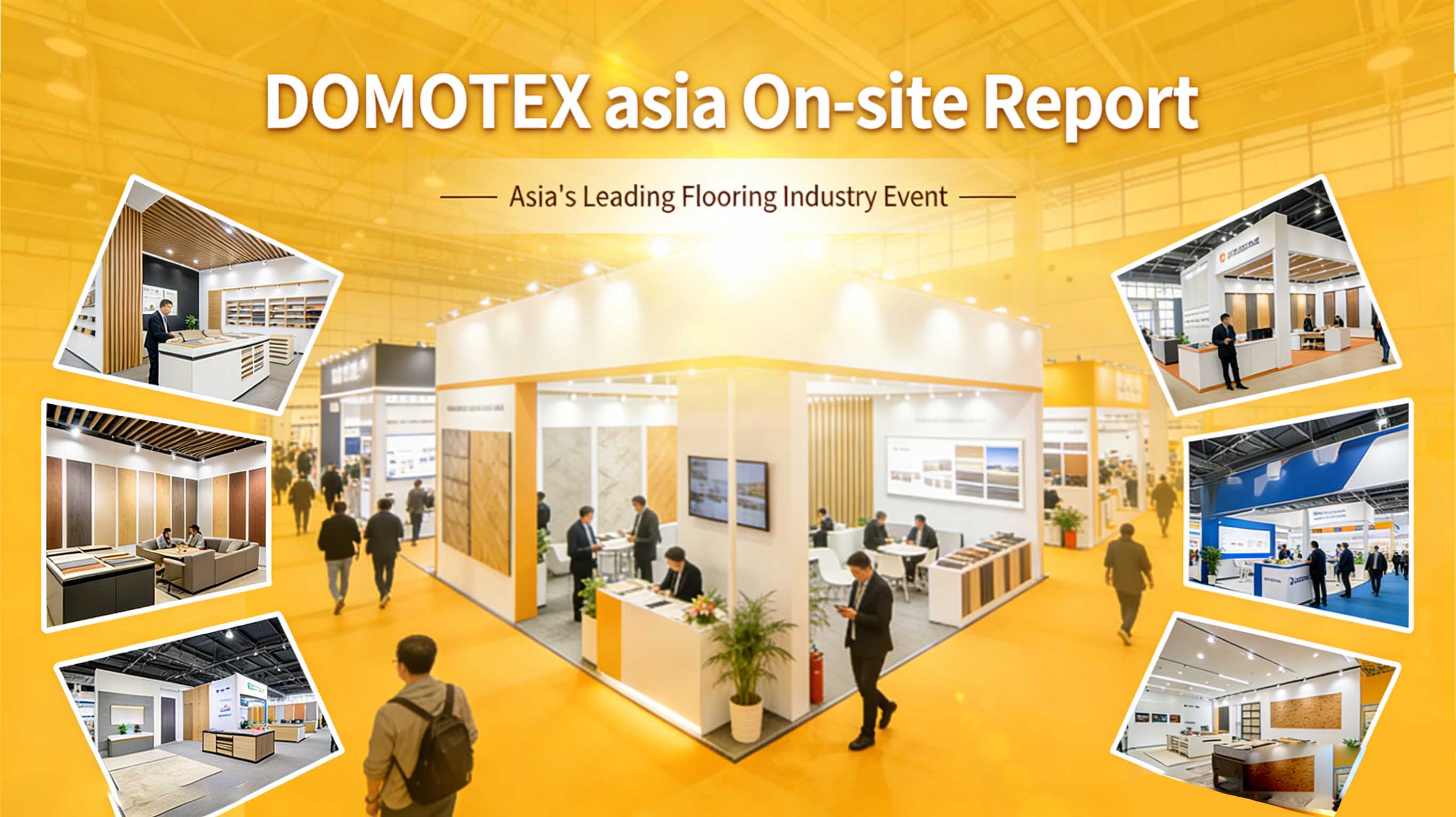
At a critical period of the transformation and upgrading of the global flooring industry, DOMOTEX Asia/CHINAFLOOR, the flagship professional flooring exhibition in the Asia-Pacific region, grandly opened at the National Exhibition and Convention Center (Shanghai). With an exhibition area of over 230,000 square meters, this exhibition gathered more than 1,600 exhibitors from all over the world and attracted over 85,000 professional visitors for communication and procurement. Among them, the special zone for flooring accessories, consumables and paving technology was upgraded again, with the core of "intelligence, environmental protection, high efficiency and adaptation". It concentrated on displaying the full range of upgraded products such as liners, molds, installation tools, cleaning equipment, adhesives and decorative articles, as well as the new intelligent, refined and integrated paving technologies, comprehensively interpreting the latest development trends of the flooring supporting industry. Intelligent paving technology and environmental accessories & consumables have become the core highlights of the exhibition, leading the global flooring supporting industry towards high-quality, green and intelligent development.
As a full industrial chain service platform for the flooring industry, DOMOTEX Asia/CHINAFLOOR has always kept pace with the industry development pulse and accurately grasped the changes in market demand.
IV. FAQ
Q1: What are the core advantages of intelligent paving technology compared with traditional paving technology?
A1: The core advantages are reflected in three aspects: first, higher efficiency. Through digital design and automated construction, the construction period can be shortened by more than 30% and human input can be reduced. For example, the intelligent paving system of Jiangsu Communications Science and Technology Group can control the paving flatness error within 2mm per meter; second, more convenient operation and maintenance. Through intelligent monitoring and early warning technologies, the pavement condition can be mastered in real time, faults can be predicted in advance, and the operation and maintenance costs can be reduced by 30%-50%; third, better environmental performance. Matching with environmental accessories & consumables can reduce pollution emissions, improve material utilization rate, and realize the recycling of consumables, in line with the "dual carbon" goals. For example, recycled aggregate paving can greatly reduce the consumption of raw materials.
Q2: What are the core gaps between domestic and international intelligent paving technologies? How to narrow the gap?
A2: The core gaps are mainly in two aspects: first, the independent R&D capability of core components (such as high-end sensors and core chips), for which China still relies on imports; second, the full-process intelligent integration capability. Foreign countries can realize the full-chain digitalization of design, construction, operation and maintenance, and recycling, while China focuses on the construction and monitoring links. The key to narrowing the gap is to increase R&D investment in core technologies, focus on the independent production of high-end components, improve the coordination of the industrial chain at the same time, promote the localized adaptation of technologies, strengthen international technological cooperation and learn from advanced foreign experience. In addition, relying on China's huge infrastructure market, realize the large-scale application of technologies and accelerate iterative upgrading.
Q3: What are the core environmental indicators of environmental accessories & consumables? How will the standards change in the future?
A3: The core environmental indicators include formaldehyde emission, heavy metal content, carbon emission, recycled material content and recyclability, and must comply with the requirements of relevant standards such as Green Building Materials Evaluation Standard - Part 57: Paving Materials (GB/T 51171-2023). In the future, environmental standards will show a trend of "global convergence and more stringency". China will further raise the control requirements for recycled material content and carbon emissions, gradually align with international standards such as the EU and the United States, and add relevant indicators for "whole-life cycle environmental protection" at the same time, forcing enterprises to improve product environmental performance and promoting the industry to develop towards low carbonization and circulation.
Q4: What is the market potential of intelligent paving technology and environmental accessories & consumables in the next 5 years?
A4: Refer to the section "Analysis of Market Potential in the Next 5 Years" in this paper. The market potential is enormous; both the global and domestic markets show a high-growth trend, with significant growth in segmented categories, continuous improvement in profit space, and dual drive of policies and demand, presenting a broad development prospect for the industry.
Q5: How can ordinary paving enterprises transform to adapt to the trends of intelligence and environmental protection?
A5: Refer to the section "Guidelines for the Transformation of Ordinary Paving Enterprises" in this paper. The core is to base on their own scale, start from three core directions of technological investment, product structure and scenario expansion, avoid the misunderstanding of blind transformation, leverage policies and industrial chain resources, strengthen talent reserve, optimize the business model, and steadily realize the intelligent and environmental transformation.


 May 26-28, 2027
 National Exhibition and Convention Center (Shanghai)