Who can Become a Global Flooring Hub
In the trend of globalization and supply chain integration in the global flooring industry, Global Floor Hub has become a core carrier connecting production and sales ends and leading industry development. It is not merely a "large-scale flooring enterprise" or a "regional wholesale market", but an industrial ecological hub with multiple functions such as resource aggregation, trade empowerment, and trend leadership.
So, what exactly is Global Floor Hub? What kind of enterprises can truly assume the role of a "global flooring hub"? This article will give clear answers from two dimensions: definition analysis and core standards, combined with industry practices and benchmark cases.
I. What is Global Floor Hub? — More Than Trade, It’s an Industrial Ecological Hub
Literally translated as "global flooring hub", Global Floor Hub is essentially an industrial platform based on a global perspective, centered on flooring products, integrating the entire supply chain resources, and providing integrated services such as trade matching, technical exchange, trend dissemination, and standard setting for manufacturers, purchasers, and service providers.
It breaks the geographical limitations, information barriers, and channel redundancy in traditional flooring trade, building an ecological system of "precise supply-demand matching, efficient service collaboration, and rapid trend transmission", and is a core node for resource allocation in the global flooring industry.
Its core characteristics can be summarized in the following three points:
1. Composite Functions: Beyond Single Trade Attribute
A global flooring hub is by no means a synonym for a "large-scale wholesaler" or an "online trading platform", but integrates multiple functions:
· Trade matching function: As a "connector" for global flooring supply and demand, it gathers global manufacturers and purchasers, providing basic services such as spot trading, bulk customization, and cross-border distribution;
· Resource integration function: Integrates supporting supply chain resources such as raw material supply, production and processing, logistics and warehousing, testing and certification, and financial payment to realize the output of "one-stop solutions";
· Technical exchange function: Builds an industry technical sharing platform to promote the cross-border dissemination and implementation of innovative achievements such as environmental protection processes, intelligent production, and installation technologies;
· Trend leadership function: Predicts changes in market demand through data analysis, industry summits, product releases, etc., and guides the R&D direction and product iteration of the industry;
· Standard setting participation function: Participates in or influences the formulation of environmental standards, quality standards, and trade rules in the global flooring industry, improving the standardization level of the industry.
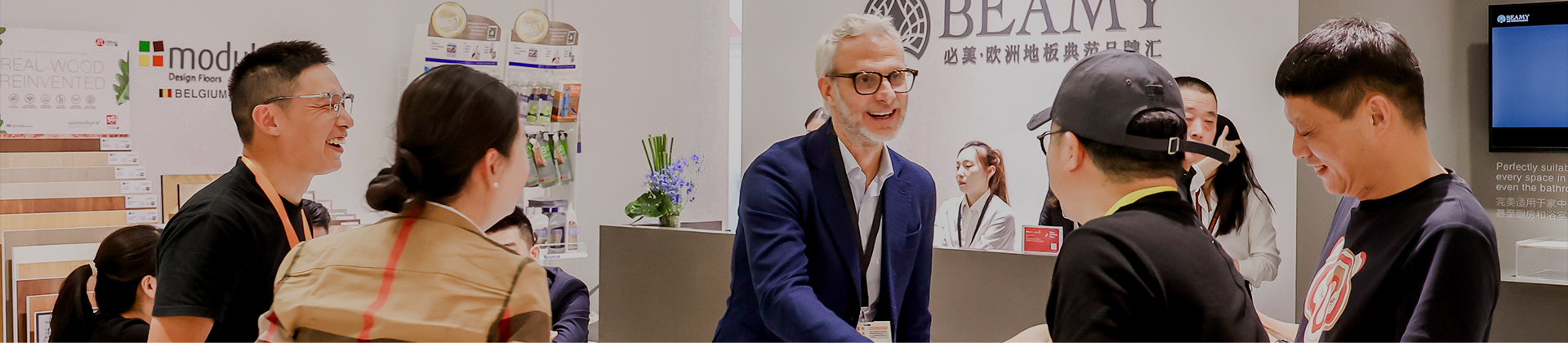
For example, DOMOTEX asia/CHINAFLOOR has built an offline global flooring hub integrating trade matching, technology display, and trend release through a 210,000-square-meter exhibition area, more than 1,500 exhibitors, and purchasers from 124 countries. Its core value has long exceeded that of an "exhibition" and has become an ecological hub for the flooring industry in Asia-Pacific and even the world.
2. Global Radiation: Possessing Global Resource Allocation Capabilities
The core symbol of a global flooring hub is "global accessibility" and "global coverage":
· Geographical radiation: Business covers core flooring markets across six continents, connecting manufacturing powers such as China, Germany, and the United States, as well as emerging consumer markets such as Southeast Asia, Africa, and the Middle East;
· Resource radius: Upstream connects global high-quality raw material bases (such as Southeast Asian rubber wood, European fast-growing forests), midstream integrates manufacturers of different production scales (from leading brands to specialized, refined, and innovative enterprises), and downstream serves diverse purchasing groups (importers, distributors, real estate developers, engineering companies);
· Cross-border services: Has mature supporting capabilities such as cross-border logistics, customs clearance, foreign exchange settlement, and compliance certification, solving pain points such as trade barriers and standard differences between different countries.
Taking Mohawk Industries in the United States as an example, through its global production base layout (the United States, China, Europe), cross-border distribution network, and multilingual service team, it has built a global supply chain system, becoming a representative enterprise of Global Floor Hub with both manufacturing and trade attributes.(Official website: https://mohawkind.com/)
3. Ecological Collaboration: Building a Win-Win Industrial Network
The core competitiveness of a global flooring hub is not "large scale itself", but "enabling win-win outcomes for ecological partners":
· For manufacturers: Provides global market access channels, demand data support, and customized production orders, helping them reduce customer acquisition costs and optimize production capacity allocation;
· For purchasers: Provides full-category product selection, quality traceability, cost optimization, and localized services, helping them improve procurement efficiency and reduce supply chain risks;
· For the industry: Promotes technological innovation, standard unification, and green development, and promotes the overall upgrading of the industry.
This ecological collaboration transforms the global flooring hub from a "single-profit enterprise" into a "multi-sided empowerment platform", forming sustainable industrial appeal.
II. What Kind of Companies Can Become a Global Flooring Hub? — Five Core Standards Are Indispensable
Not all large-scale flooring enterprises or traders can become a global flooring hub. It needs to meet five core standards: resources, services, technology, network, and credibility, and possess comprehensive capabilities of "aggregation - empowerment - leadership".
1. Core Standard 1: Global Resource Integration Capability — Holding "End-to-End Discourse Power" in the Supply Chain
The primary condition for becoming a global flooring hub is the ability to integrate the entire supply chain resources of the flooring industry from upstream raw materials to downstream terminals, rather than being limited to a single link of "production" or "trade".
· Upstream resources: Establish long-term strategic cooperation with global core raw material bases (such as Southeast Asian teak, African red sandalwood, European spruce producing areas) or large raw material suppliers to ensure the stable supply and cost advantage of core raw materials such as wood, PVC, and limestone;
· Midstream manufacturing: Either has its own global production layout (such as setting up factories on different continents to adapt to regional market needs), or integrates more than 100 high-quality global manufacturers, covering full-category flooring such as solid wood, SPC, LVT, and carpets, to meet the quality, price, and functional needs of different markets;
· Downstream channels: Has mature distribution networks, logistics and warehousing nodes, or partners in major global markets (North America, Europe, Asia-Pacific, Middle East, Africa) to ensure that products can quickly reach terminal purchasers.
Case Reference: By integrating more than 1,500 global flooring brands and manufacturers, linking wood-producing area associations upstream, and connecting purchasers from 124 countries downstream, DOMOTEX asia has formed an end-to-end resource integration capability of "raw materials - production - trade - terminals", becoming a core global flooring hub in the Asia-Pacific region.
2. Core Standard 2: Full-Scenario Trade Service Capability — Solving "Full-Process Pain Points" in Cross-Border Trade
Cross-border flooring trade involves multiple complex links such as logistics, customs clearance, certification, and payment. Enterprises aiming to become a global flooring hub must have "one-stop trade service" capabilities to clear obstacles for both supply and demand sides.
· Customized trade solutions: Provide flexible cooperation models according to purchasers' needs (batch size, delivery cycle, customization requirements), such as bulk procurement, small-order customization, spot direct delivery, and engineering supporting services;
· Cross-border supporting services: Integrate international logistics giants (such as Maersk, COSCO Shipping) to provide door-to-door logistics services; be familiar with customs clearance policies and tariff rules of different countries to provide compliant customs clearance support; connect with cross-border payment platforms and financial institutions to provide services such as letters of credit, foreign exchange settlement, and financing guarantees;
· Compliance certification services: Assist manufacturers' products in meeting certification standards of different global markets (such as EU CE, US CARB, Japan F4 Star, China E0 Grade), and provide testing and certification agency services to ensure products smoothly enter target markets.
Case Reference: Through the full-chain service of "global procurement + localized warehousing + installation and after-sales", The Home Depot in the United States provides market access support for global flooring manufacturers and "product selection - distribution - installation" integrated services for local purchasers, becoming a flooring trade service hub in the North American market.
3. Core Standard 3: Technological Innovation and Trend Leadership Capability — Grasping the "Future Discourse Power" of the Industry
A global flooring hub cannot only be a "resource transporter", but also a "industry vane", with the ability to promote technological innovation and predict market trends.
· Product technology iteration: Either has a strong R&D team to promote innovations in flooring materials (such as environmental protection and formaldehyde-free, renewable materials), processes (such as 3D printed textures, intelligent locking), and functions (such as antibacterial, anti-slip, intelligent monitoring); or can quickly aggregate industry innovative achievements and promote cutting-edge technology products to the global market;
· Trend insight and dissemination: Integrate global trade data and consumer demand data to release industry trend reports, revealing development directions such as environmentalization, customization, and scenarioization; promote the upgrading of design styles, functional needs, and application scenarios of global flooring through industry summits, product launches, etc.;
· Standard participation and formulation: Participate in the formulation or revision of international or regional flooring industry standards (such as environmental standards, quality standards, installation standards), transforming its own technical advantages into industry rules and enhancing global industry discourse power.
Case Reference: Through R&D in environmental linen flooring and antibacterial resilient flooring, Forbo Group in Switzerland leads the formulation of European green flooring standards, and at the same time promotes environmental flooring solutions to the global market through the Global Floor Hub network, leading the industry's green transformation.
4. Core Standard 4: Global Network and Localized Operation Capability — Achieving "Global Coverage + Local Adaptation"
There are significant regional differences in the global flooring market (such as climate adaptation, consumer preferences, trade rules). Enterprises aiming to become a global flooring hub must have the balanced capability of "global layout + localized operation".
· Global network layout: Establish branches, distribution centers, or production bases in core markets, such as focusing on China and Southeast Asia in Asia, Germany and France in Europe, and the United States and Canada in North America, forming a network structure of "hub radiation + regional nodes";
· Localized adaptation capability: Adjust products and services according to the market characteristics of different regions, such as promoting moisture-proof SPC flooring for the humid climate in Southeast Asia, FSC-certified solid wood flooring for the high-end European market, and cost-effective laminate flooring for the African market;
· Multilingual and cultural adaptation: Have a professional multilingual team, familiar with the business culture and negotiation habits of different regions to ensure smooth cross-cultural communication; establish a localized after-sales service team to solve terminal problems such as installation and maintenance.
Case Reference: Gerflor Group in France has established branches in more than 100 countries around the world, launching adaptive products for different regions (such as FIBA-certified sports flooring for stadiums in the Middle East and antibacterial resilient flooring for hospitals in Asia), achieving in-depth integration of "global resources + local services".
5. Core Standard 5: Industry Credibility and Ecological Collaboration Capability — Becoming an "Industrial Trust Hub"
The core of a global flooring hub is "trust". Only with a high degree of industry credibility and ecological collaboration awareness can it gather global industrial chain resources and achieve sustainable development.
· Credibility building: Have a long-term and stable business history (usually more than 10 years), with product quality and service level recognized by global customers; obtain authoritative certifications such as ISO and FSC, without major quality disputes or compliance issues; have open and transparent trade rules and price systems, eliminating vicious competition or information asymmetry;
· Ecological collaboration awareness: Do not pursue "one-sided monopoly", but empower all parties in the industrial chain through open cooperation, such as providing market channels for small and medium-sized manufacturers, resource docking for purchasers in emerging markets, and cooperation platforms for industry service providers;
· Social responsibility: Promote the sustainable development of the industry, such as supporting responsible forestry logging, promoting environmental protection production processes, and reducing carbon emissions in the supply chain; participate in public welfare projects (such as flooring donations for post-disaster reconstruction, infrastructure support in poverty-stricken areas) to enhance global brand reputation.
Case Reference: Through 27 years of industry accumulation, DOMOTEX asia has established an industry reputation of "professionalism, transparency, and win-win". The exhibitor satisfaction rate reaches 7.6 points, and the buyer repurchase intention reaches 90%. At the same time, it empowers the collaborative development of the industrial chain by promoting green flooring exhibitions and industry innovation summits, becoming a highly credible Global Floor Hub.
The Essence of a Global Flooring Hub is a "Value-Co-Creation Platform"
In summary, a global flooring hub is not a simple "large-scale enterprise" or "wholesale market", but an industrial ecological hub with global resource integration, full-process trade services, technical trend leadership, global network operation, and industry credibility. The core of becoming a global flooring hub lies not in "how large the scale is", but in "how much value it can create for the industry" — whether it can enable manufacturers to reach the global market more efficiently, purchasers to obtain high-quality products more conveniently, and the industry to develop in a more standardized, innovative, and sustainable direction.
For Chinese flooring manufacturers, it is necessary to rely on the global network of the global flooring trade hub, strengthen environmental protection and customization capabilities, and accurately layout emerging markets; for global purchasers, the Domotex asia/CHINAFLOOR platform provides an efficient, transparent, and reliable procurement channel to help them reduce costs and grasp trends; for entrepreneurs, the market dividends of whole-house customization and mature franchise systems provide a high-quality path to enter the home furnishing industry.
In the future, only enterprises that comply with market trends, embrace digital transformation, and focus on customer value can seize opportunities in the global trade ecosystem built by the global flooring trade hub and achieve sustainable growth.


 May 26-28, 2027
 National Exhibition and Convention Center (Shanghai)